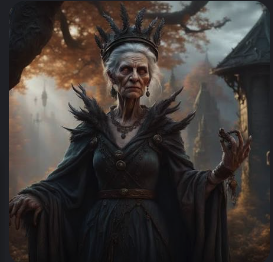
There is a stage of a woman’s life that our culture often struggles to name.
We know how to celebrate youth. We know how to talk about becoming a mother, building a career, raising a family, creating a home, achieving, producing and caring for others.
But what happens when a woman enters the years beyond these identities?
Who does she become when she is no longer expected to be young, desirable, endlessly available, or defined by what she does for others?
In many ancient traditions, there was a name for this woman: the Crone. – also known as the ‘Crowned One’ (later disparaged by patriarchy)
The Crone was not simply an old woman. She represented wisdom, discernment, sovereignty, transformation and the knowledge that comes from having lived through many seasons of life.
To become a Crone is not to become irrelevant.
It is to become deeply yourself.
The Crone as an Archetype
The word Crone can sometimes feel uncomfortable in a culture that has taught women to fear ageing.
For many of us, “old woman” has been associated with invisibility, decline or loss. The cultural message is often that a woman’s value diminishes as her youth does.
The Crone archetype offers another story.
She reminds us that ageing can be an initiation rather than a diminishment. Ie, Saging vs Aging, Rewiring vs Retiring
The Crone has lived.
She has loved and lost. She has made mistakes. She has survived endings. She has begun again. She has experienced joy, grief, disappointment, desire, change and uncertainty.
She has learned that not everything needs to be fixed. Not every battle needs to be fought.
Not every person needs to like her.
And not every expectation deserves her obedience. This is part of the freedom of becoming an elder. From Doing to Being
Much of a woman’s earlier life can be organised around doing. We achieve.
We care.
We build.
We work.
We raise children.
We support partners, families, communities and organisations.
We become skilled at anticipating the needs of everyone around us.
But eventually, life may ask a different question:
Who are you when you are no longer defined by what you do for everyone else?
This can be confronting.
It can also be liberating.
Eldership invites a woman to move from constant doing into a deeper form of being.
Her value is no longer dependent on productivity.
Her wisdom does not need a title.
Her presence can become enough.
This doesn’t mean withdrawing from life. Quite the opposite.
It can mean participating in life with greater intention.
Eldership Is Not Just About Age
Age alone does not make someone an elder.
Eldership is cultivated.
It asks something of us.
It asks us to metabolise our experiences rather than simply accumulate them.
We can grow older without growing wiser. We can experience hardship without allowing it to deepen us. We can collect years without becoming more compassionate, courageous or discerning.
Eldership begins when experience becomes wisdom. A woman begins to ask:
What have I learned?
What am I ready to release?
What is worth passing on? What no longer belongs to me?
How can my life experience serve those who come after me?
These questions transform ageing from something that merely happens to us into a conscious stage of development.
The Gift of Perspective
One of the gifts of eldership is perspective.
When we are young, everything can feel urgent.
A rejection can feel like the end of the world. A career setback can feel like failure. A relationship ending can feel like the loss of our future.
With time, we begin to see patterns.
We learn that endings can become beginnings.
We learn that some things we desperately wanted were not necessarily good for us.
We learn that people reveal themselves over time.
We learn that certainty is often an illusion.
And perhaps most importantly, we learn that life is not a straight line.
There are seasons.
There are cycles.
There are deaths and rebirths within a single lifetime.
The elder woman can carry this knowledge in her body and her presence.
She knows that winter is not the end of the story.
The Courage to Become Invisible
One of the great fears surrounding ageing for women is invisibility.
Our culture often rewards women for being attractive, youthful and sexually desirable. As these qualities become less culturally prized, women can experience a painful sense of being overlooked.
But there can be another way of understanding invisibility.
What if becoming less visible to the gaze of others creates space to become more visible to ourselves?
What if we no longer need to perform femininity for approval?
What if we can dress for ourselves, speak more honestly, take up space differently, or choose not to take up space at all? The Crone does not need to be constantly seen.
She has developed an inner authority.
She can say:
I know who I am.
And perhaps even more importantly:
I know who I am not.
Eldership and the Younger Generations
Eldership is also relational.
An elder carries something forward.
She becomes a bridge between generations.
This does not mean telling younger women how to live. True eldership is not about imposing one’s experience as universal truth. Instead, it is about offering wisdom without demanding obedience.
An elder might say:
“This is what I learned.”
“This is what I wish someone had told me.”
“This is where I made a mistake.”
“This is what I still don’t know.”
There is humility in that.
The deepest elders do not need to have all the answers.
They know how to ask better questions.
They know how to listen.
They know when to speak and when to step back.
And they understand that every generation must ultimately find its own way.
The Crone as Keeper of What Matters
Perhaps one of the most beautiful aspects of the Crone archetype is her relationship with what is essential.
As life unfolds, we often become less interested in appearances and more interested in truth.
Who is trustworthy?
What brings meaning?
What relationships nourish us?
What values are worth defending?
What can be released?
What deserves our remaining energy?
The elder woman can become a keeper of what matters.
Not because she is perfect, but because she has lived long enough to understand the difference between what is urgent and what is important.
She can become a keeper of stories, traditions, recipes, rituals, memories, skills and family histories. But she can also become a keeper of something less tangible:
the memory of who we are.
Becoming a Crone Is an Initiation
Perhaps becoming a Crone is not something that happens automatically when we reach a particular birthday. Perhaps it is an initiation.
It begins when we recognise that an old version of ourselves is dying.
The woman who needed everyone’s approval.
The woman who said yes when she meant no.
The woman who measured her worth through appearance. The woman who believed she had to carry everything.
The woman who was frightened of disappointing others. These identities may have served us once.
But there comes a time when they become too small.
The Crone asks us to let them go.
This can be painful.
Transformation usually is.
But beyond the letting go is another kind of power.
A quieter power.
A more embodied power.
The power of knowing yourself.
A New Story About Ageing
Perhaps women need a new cultural story about ageing.
One in which becoming older does not mean becoming less.
One in which wrinkles can be read as evidence of a life rather than something to erase.
One in which menopause, ageing, sexuality, grief, freedom and reinvention can be discussed openly. One in which older women are not expected to disappear.
And one in which wisdom is valued alongside achievement.
The Crone gives us language for this possibility.
She says that a woman can enter the later chapters of her life with curiosity rather than shame.
She can become more discerning.
More spacious.
More truthful.
More sovereign.
More generous with her wisdom.
And perhaps more willing to live according to what she knows rather than what the world expects. The Invitation of Eldership
Not every woman will identify with the word Crone, and she doesn’t need to.
The language is less important than the invitation behind it.
The invitation is to recognise that every stage of a woman’s life carries its own gifts.
Youth has its gifts.
Motherhood has its gifts.
Creativity has its gifts.
Maturity has its gifts.
And elderhood has its gifts.
The question is not , How do I stay young?
Perhaps the deeper question is:
Who am I becoming?
And eventually:
What wisdom and legacy will I leave behind?
Becoming a Crone is not about becoming an old woman.
It is about becoming a woman who has lived deeply enough to know what matters.
A woman who can stand at the threshold between generations.
A woman who carries the stories of those who came before and helps make the path clearer for those who come after. A woman who no longer needs to prove her worth.
A woman who knows that her life is not becoming smaller.
It is becoming deeper.
And that may be the true gift of eldership.

Comments are closed