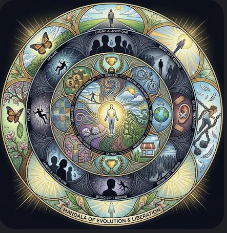
There is a particular moment in a woman’s life when she begins to realise that becoming is not about becoming more.
It is about becoming more fully herself.
For much of our lives, we are encouraged to become something.
Become a good girl.
Become beautiful.
Become successful.
Become a partner.
Become a mother.
Become accomplished.
Become someone others can be proud of.
We are given identities, roles and expectations, and often we become remarkably skilled at inhabiting them.
But beneath all those layers is another question, quieter and more persistent:
Who am I beneath everything I have been taught to be?
This is where the art of becoming begins.
Becoming Is Not a Destination
We often imagine personal development as a journey towards a finished version of ourselves.
We will eventually become confident enough, healed enough, successful enough, spiritual enough, wise enough.
Then, perhaps, we will finally arrive.
But life doesn’t work that way.
There is no final version of us.
We are continually shaped by experience, relationships, loss, love, ageing, disappointment, courage and change.
Becoming is therefore not a project of self-improvement.
It is a process of self-discovery.
It is learning to listen to the person who is emerging rather than constantly trying to perfect the person we think we should be.
Carl Rogers explored this idea deeply in On Becoming a Person, a foundational work in humanistic psychology. Rather than presenting the self as something that needs to be manufactured, Rogers explored the movement towards greater authenticity and congruence.
Perhaps becoming is less about constructing a new self and more about removing what prevents the real self from being heard.
The First Half of Life: Becoming Who We Are Expected to Be
For many women, the first half of life involves building.
We build careers.
Relationships.
Families.
Homes.
Reputations.
Identities.
We learn how to function in the world.
And there is nothing inherently wrong with this.
These experiences can be deeply meaningful.
But somewhere along the way, a woman may begin to sense a discrepancy between the life she has created and the life her inner self is asking for.
She may find herself asking:
Is this really my life?
What do I want now?
What have I been doing because I genuinely wanted it—and what have I done because it was expected of me? What parts of myself have I abandoned along the way?
These questions can arrive through midlife, but they are not limited to a particular age.
They can arise after divorce, menopause, children leaving home, career change, bereavement, illness, retirement—or simply through the growing awareness that time is finite.
The old map no longer seems sufficient. And that can be frightening.
It can also be an invitation.
The Art of Letting Go
Becoming requires both creation and release.
We cannot become who we are without allowing some versions of ourselves to die. This is one of the less comfortable truths of personal growth.
We may need to let go of being the person who keeps everyone happy.
The person who never says no.
The person who needs external validation.
The person who believes she must remain useful to deserve love.
The person who is frightened of disappointing others.
The person who has confused being needed with being valued.
Letting go can feel like loss because these identities have often protected us.
They helped us belong.
They helped us survive.
They helped us navigate the expectations of our families and cultures.
But what once protected us may eventually constrain us.
Becoming asks:
Does this still belong to me?
From Approval to Authenticity
One of the great developmental movements of adulthood is the movement from external approval towards internal authority. As young women, we may spend enormous energy wondering what other people think.
Am I attractive enough?
Successful enough?
Good enough?
Interesting enough?
A good enough partner?
A good enough mother?
A good enough daughter?
Eventually, something can shift.
We begin to realise that living for approval is exhausting.
Authenticity becomes more important than applause.
This does not mean becoming selfish or indifferent to others.
It means developing the capacity to remain connected to ourselves while being in relationship with others.
Brené Brown’s work on wholehearted living similarly emphasises authenticity, worthiness and the courage to embrace our imperfect lives rather than constantly performing an idealised version of ourselves. Her website also provides discussion guides and other resources for readers wanting to explore these themes further.
The question changes from:
“Will they approve of me?”
to:
“Is this true for me?”
That is a profound shift.
Becoming Through the Shadow
Becoming is not only about discovering our gifts.
It also involves meeting the parts of ourselves we have rejected. The angry woman.
The ambitious woman.
The sensual woman.
The selfish woman.
The vulnerable woman.
The woman who wants something different. The woman who is tired.
The woman who doesn’t want to care for everyone anymore.
The woman who has desires that don’t fit neatly into the identity she has created.
These parts can frighten us because we have often been taught that certain aspects of ourselves are unacceptable. Psychological growth requires curiosity towards these disowned parts.
Instead of asking, “How do I get rid of this?”
we can ask:
“What is this part of me trying to tell me?”
The goal is not to act on every impulse.
It is to become conscious of ourselves.
Wholeness does not mean being perfect.
It means becoming less divided within ourselves.
The Second Half of Life: A Different Kind of Becoming
The second half of life can bring a different developmental task.
James Hollis, in Finding Meaning in the Second Half of Life, describes this period as an opportunity to question inherited roles and move towards a life that is more deeply one’s own. His work draws on Jungian psychology and explores the movement towards greater meaning and authenticity in midlife and beyond.
This is especially significant for women.
For years, we may have been becoming what the world needed us to become. The later years can offer an opportunity to ask:
What does my soul need me to become now?
This is a different question.
It isn’t primarily about achievement.
It is about meaning.
It is about depth.
It is about choosing what deserves the energy of the years ahead.
Becoming the Elder
This is where the art of becoming meets eldership.
An elder is not simply someone who has accumulated years.
An elder is someone who has worked with those years.
She has reflected on experience.
She has learned from mistakes.
She has survived endings.
She has developed discernment.
She has become more comfortable with complexity.
And she has something to offer the generations that follow.
The elder doesn’t need to tell younger women exactly what to do.
She can offer something more valuable:
perspective.
She can say:
“I have been there.”
I learned this the hard way.”
“You don’t have to repeat my mistakes.”
“And ultimately, you must find your own way.”
This is the generosity of mature wisdom.
It does not demand imitation.
It supports emergence.
Becoming a Crone
The archetype of the Crone offers another language for this stage of becoming.
Rather than viewing ageing as decline, the Crone represents a woman who has entered a different relationship with power, time and identity .
She has less interest in performing. More interest in truth.
Less interest in pleasing.
More interest in integrity.
Less interest in accumulating.
More interest in meaning.
The Crone understands that life is cyclical.
There are beginnings.
There are endings.
There are seasons of growth and seasons of retreat.
There are things to hold onto and things that must be released.
She does not try to remain permanently in spring.
She understands the wisdom of winter.
And perhaps this is one of the great gifts older women can offer our culture: permission to age.
Permission to change.
Permission to become something other than what we were.
Becoming Is an Act of Courage
There is courage in becoming because becoming requires uncertainty.
We cannot always see who we are becoming while we are in the process.
There may be a period when the old identity no longer fits but the new one has not yet emerged. This is the threshold.
It can feel like confusion.
Like emptiness.
Like failure.
Like being lost.
But perhaps we are not lost.
Perhaps we are between identities.
Rollo May’s work on creativity and existential courage is useful here: creating a life requires engaging with uncertainty rather than waiting until everything is guaranteed. Becoming asks us to participate in our own lives even when we cannot see the entire path ahead.
Sometimes the next step becomes visible only after we take the one before it.
A Practice of Becoming
The art of becoming does not require a dramatic reinvention.
It can begin with small acts of listening.
Ask yourself:
What am I longing for?
What am I tolerating that I no longer want to tolerate?
What parts of myself have I silenced?
What am I ready to release?
Where am I living according to someone else’s definition of success? What brings me alive?
What have I learned that is worth passing on?
What kind of woman am I becoming?
And perhaps the most important question:
What would my life look like if I trusted myself more?
You don’t need to answer all these questions immediately.
Some questions are not problems to solve.
They are companions for the journey.
The Beauty of Not Knowing
There is a particular kind of wisdom that comes with becoming comfortable with not knowing. We don’t always know what comes next.
We don’t always know who we will become.
We don’t always know whether a decision will work out.
We don’t always know what an ending is making space for.
And perhaps we don’t need to know.
The art of becoming asks us to remain curious.
To keep listening.
To allow life to surprise us.
To recognise that transformation rarely happens in a straight line. We circle back.
We revisit old wounds.
We discover new layers.
We change our minds.
We outgrow identities.
We begin again.
Again and again.
Becoming, Not Arriving
Perhaps the deepest lesson is this:
You are not late.
You are not behind.
You are not supposed to have yourself completely figured out. You are a living, evolving human being.
There will always be another layer to discover.
Another truth to integrate.
Another part of yourself waiting to be welcomed home.
The goal isn’t to arrive at some perfect final self.
The goal is to become increasingly intimate with your own life.
To live with greater awareness.
To choose with greater consciousness.
To love with greater depth.
To release what is no longer yours.
And, eventually, to become the woman who can look back across the many versions of herself and say: I understand why you became her.
I honour who you were.
And I am grateful for who you are becoming.
That is the art.
Not becoming someone else.
But becoming, more and more, yourself.
Resources for the Journey of Becoming
1. On Becoming a Person — Carl Rogers
A classic work from humanistic psychology exploring authenticity, personal growth and the movement towards becoming a more fully functioning person. It is a useful foundation for thinking about becoming as an unfolding process rather than a destination.
Explore On Becoming a Person through Hachette Australia
2. Finding Meaning in the Second Half of Life — James Hollis
Particularly relevant for anyone exploring midlife, ageing, identity and the transition from externally defined success towards a more personally meaningful life. Hollis approaches these questions through a Jungian lens.
Explore the book through Penguin Books Australia
3. James Hollis — Jungian resources
Hollis’s website provides information about his books and work, including resources on midlife, individuation, meaning and the examined life.
James Hollis — Books and resources
4. Brené Brown — The Gifts of Imperfection
A useful companion for exploring authenticity, vulnerability, worthiness and wholehearted living. Brown also provides free discussion guides, workbooks and other resources connected to her books.
Brené Brown — Resources
5. Journaling as a Practice
Consider creating a dedicated Becoming Journal.
Rather than recording only what happened each day, use it to explore your inner development. Begin each entry with one question:
What is emerging in me?
What am I releasing?
What am I learning?
What wants my attention?
Where am I becoming more myself?
Over time, the journal becomes a record not simply of your life events, but of your evolution.
A final reflection
Becoming is not something we complete.
It is something we practice.
Every ending can become an invitation.
Every transition can reveal something.
Every age can offer a new way of seeing.
And every woman carries within her the possibility of becoming more conscious, more whole and more deeply rooted in her own truth.
The question is not, “Who should I become?”
The question is, “Who am I becoming—and what is asking to emerge through me now?”

Comments are closed